How Lasair Works ∞
Lasair runs in the Somerville computing cloud at the Advanced Computing Facility near Edinburgh, Scotland.
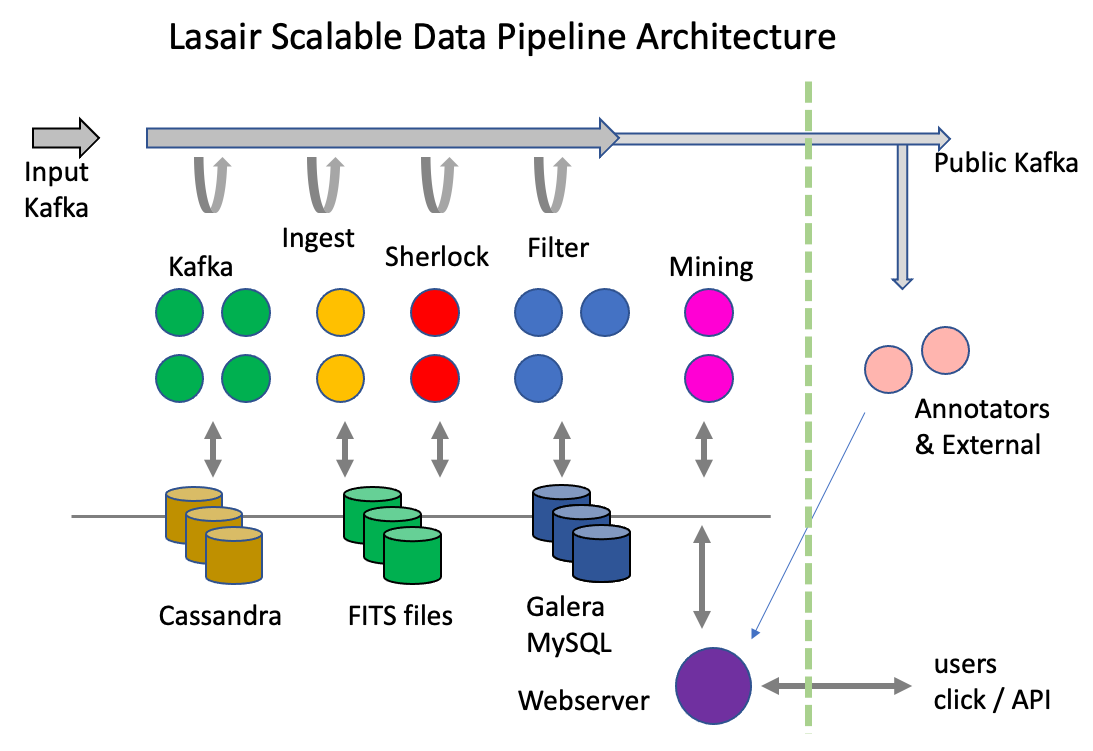
Lasair ingests data with a pipeline of clusters: each cluster does a different job, some more compute/data intensive than others, so it is difficult to know a priori how much resource should be allocated to each. Our design gives flexibility: each cluster can be grown or reduced according to need. Also, there are various persistent data stores, again, each is driven by a resilient cluster that can be grown or reduced according to need. The diagram shows the concept: data enters the Kafka system on the left and progresses to the right. The green cluster reads, processes, and puts different data into the Kafka bus; as soon as that starts the yellow cluster pulls and pushes; eventually the whole pipeline is working. The clusters may also be reading and writing the data stores. We also include the web and annotator nodes in this picture (bottom and right), as well as the mining nodes, although they are not part of the data ingestion pipeline. The web server nodes support users by delivering web pages and responding to API requests. The annotator nodes may be far from the Lasair computing centre and not controlled by us, but they are in this picture because just like the others, they push data into the data storage and may read from Kafka.
The Kafka system is represented by the green nodes in the diagram as well as the grey arrow at the top. It is responsible for reading and caching the alert packets from the USA, as well as sending it to the compute nodes and receiving their resulting packets.
The Ingest nodes read the original alerts alerts from the Kafka system, and puts the cutout images in the shared filesystem, the recent lightcurve to NoSQL (Cassandra) database, then reformats the alert as JSON – since there is no binary content – then pushes that into the Kafka system.
Each Sherlock node has a SQL database of 5 Tbytes of astronomical sources from ~40 catalogues. The sky position of the input alert is used to intelligently decide on the most likely associated source from the catalogues, finding out, for example, if the alert is associated with a known galaxy, or if the alert is a flare from a known CV (cataclysmic variable).
Each filter node computes features of the 30-day light curve that comes with the alert (a year with LSST), as well as matching the alert against user-made watchlists and areas. Records are writen to a local SQL database onboard the node for the object and features, the Sherlock data, the watchlist and area tags. Other tables have already been copied into the local database from the main SQL database (see Background Services below). After a batch of perhaps 10,000 alerts are ingested to the local database, it can now execute the user-made queries and push out results via the public Kafka system – or via email if the user has chosen this option. NOTE User-made queries have a time-out of 10 seconds, so they can’t hold up the entire system if they are too resource intensive. Usually, however, a user query will execute in a second or less since there are only 10,000 objects in the local database.
The tables in the local database are then pushed to the main SQL database and replace any earlier information where and object is already known. Once a batch is finished, the local database tables are truncated and a new batch started.
The Lasair webserver and API server allow users to control their interactions with the alert database and the stream. They can create a watchlist of their interesting sources, and Lasair will report crossmatches with members of the watchlist. They can define regions of the sky, and Lasair will report when alerts fall inside a region. They can define and save SQL queries that can run in real time as filters on the alert stream.
The Lasair API supports annotation: a structured external packet of extra information about a given object, that is stored in the annotations table in the SQL database. This could be, the result of running a machine-learning algorithm on the lightcurve, the classification created by another broker, or data from a follow-up observation on the object, for example a link to a spectrum. Users that put annotations into the Lasair database are vetted, and administrators then make it possible. That user will run a method in the Lasair API that pushes the annotation: all this can be automated, meaning the annotation may arrive within minutes of the observation that triggers it.
ZTF and LSST ∞
The Lasair project splits into two: the existing working version, Lasair-ZTF, that has been ingesting and exposing alerts from the ZTF survey for two years; and the future version Lasair-LSST, which is being developed based on the lessons learned from Lasair-ZTF. We are keeping the essentials of the user interface of Lasair-ZTF (static and streaming SQL queries, full database access, watchlists, classification and annotation), but are rebuilding the backend architecture for LSST event rates, using parallel services and scalable software.
In the timeframe beyond the first data releases of LSST, we can expect continuing change. New surveys will come on line, new robotic follow-up systems, and new classification systems will proliferate, leading to more real-time transient streams and derived information. Just as cross-matching of static catalogues has gained importance in the last years, so dynamic cross-matching will become an engine of discovery: those transients observed by A and B, or classified in contradiction by C and D. While the bulk of data will continue to be dominated by Rubin data, there will be a deluge of metadata and annotation. Lasair will be well-suited to this challenge, building on our existing mechanisms for dynamic cross-match (e.g. the IAU’s Transient Name Server) and utilising our flexible schema system. Lasair will add new tables and schemas to our databases, and build information systems to make it easy for scientists to navigate the deluge of metadata.
Decisions from the Alert Packet ∞
Lasair is built to process transient alerts rapidly and make the key decision: is this an object I want to follow up? LSST alerts will come at very high rate, and Lasair takes advantage of the design of the distribution system: “Events are sent in rich alert packets to enable standalone classification”. Thus alerts are judged based only on that rich alert packet, without database interaction, leading to a very fast processing rate.
The “rich data packet” means a year of past data about each object (or a month for the ZTF prototype). Note that Lasair has the full light curves – available through the object web page or API – but queries and filters are based on these shorter light curves.
We note that the calibrated ZTF data releases are hosted at Caltech and the LSST archives will hosted by LSST:UK Science Platform and Rubin Science Platform. These resources may be better suited for long-term archival research.